
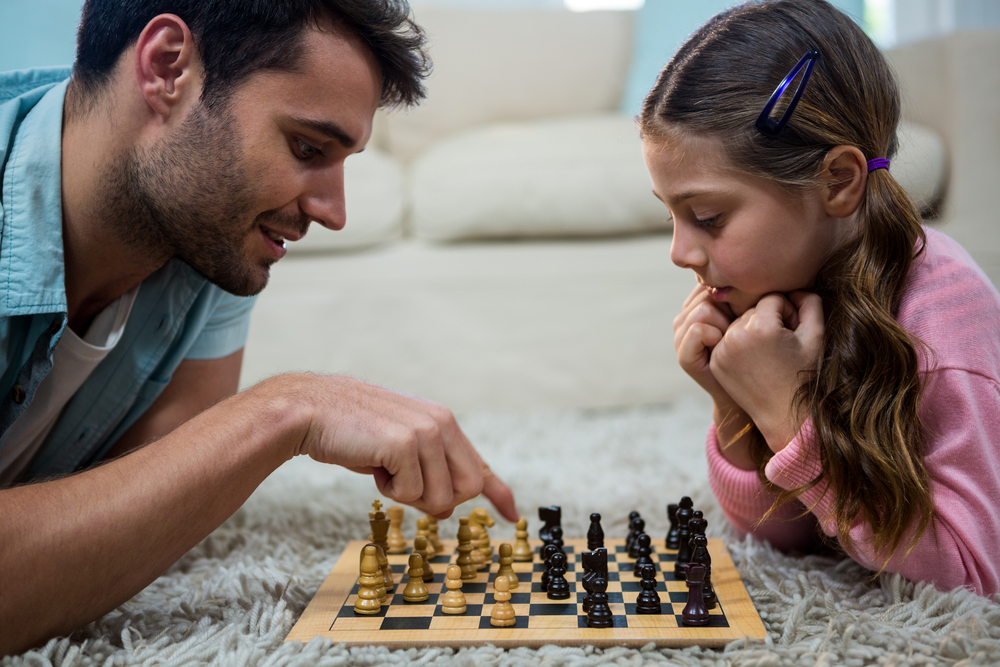
As maintained above, classical education beyond the grammar level is founded upon the notion that clear, precise, and rigorous thought is a more important attribute of student achievement than the memorization or regurgitation of facts. And perhaps no intellectual activity demands, for that matter, the alacrity or logical prowess that the game of Chess demands. Keen foresight with a reasoned inhibition to threat; poise, patience, and prudence in the attack; and a deep exercise of every neuron of intellectual ability are all required to be a good - or even a fairly-good, player of chess. It is little wonder that classical schools gravitate toward chess as an extra-curricular activity, as it would be a shame to eschew such a tool and art in the formation of children who otherwise engage the balance of the Western mind and soul.
Each game of chess, no matter how executed or how contrived, possesses three main stages of development. The opening (comprising the first 5-6 moves of each game) is the time in which forces are massed and initial positions are taken. The midgame (usually comprising the next 20-30 or so moves) is the time in which strategies used in support of the opening lead to strategic conclusions and positions of defense and offense form. Finally, the endgame, comprising perhaps the last 10-25 moves of each game, is a time of intense creativity on the part of both players, as they dodge and desist the final, deathly conclusion - checkmate, and victory for the foe. It can be maintained that the three stages of the chess game correspond, at least roughly, to the three core stages of the Trivium (grammar, logic, and rhetoric), and that the modes and themes of these stages largely mirror the modes and themes of the classical model.
Like the content in the grammar stage, openings and their variations must be exhaustively memorized to produce a quick repertoire of effective countermeasures against the early aggressions of the other player. And it is no wonder that grammar-level students delight so much in constructing the great historical openings of the game: the Ruy Lopez, Queen's Gambit, Sicilian Openings, 4-Knights opening, Vienna, Catalan, etc. Such students can, with sufficient care, be made to appreciate the benefits of having a ready knowledge of openings. Masters also learn chess openings from their masters in a classical manner, first beginning with the openings and progressing to the more reasoned tread of the midgame, in which the advantages are stored and garnered before effloresce, in the hope of each player, into a distinct numerical or positional advantage. The midgame, like the logic stage of classical education, stresses effective strategy. The midgame requires an unceasing attention to detail and a boundless enthusiasm to "think ahead" and reason through the complex and far-reaching consequences of long-term goals. It is no wonder that logic-school students excel so masterfully at the midgame, with its mechanical, plodding, and possibly underwhelming evolution of positions and expectations. Finally, as in the poetic stage of classical education, the endgame stresses elegance instead of raw force, and masters have been known to delay inevitable checkmates just to ensure that the end of the game is "beautiful" - that is, completed in the most concise possible way, with the least "out of the way" maneuvering and the fewest pieces possible. As in rhetoric, Chess is a game of persuasion - both of oneself and the other player - that the conclusion is, in fact, not inevitable. To mind come a million ideas of how the game could have changed, how it could have been cleaner, and (for the defeated), what might have changed the denouement.
In summary, chess should be an integral portion of a balanced classical curriculum, not for the least reason that the game parallels and uniquely reinforces classical education in all of its stages.
- Jonathan Kenigson